From our parents, we received a unique code in the form of genetic information stored in our DNA. However, it is largely up to us to decide which of these genes actually manifest themselves. How is this possible and through what channels? This is what the field of epigenetics is trying to explain.
We used to think that genetics predestined our destiny. So why is it that identical twins, who share the same DNA and are almost indistinguishable in childhood, often look different, suffer from different diseases and live to different ages in adulthood?
And what about the bees – all of them, living in one hive, have the same genetic information, and yet there are both tiny infertile workers that live for a few weeks, and a large queen that lives for several years and lays thousands of eggs. How is this possible?
The answer is that not all genes in DNA are equally active. Some are switched on, so they make proteins, others are switched off, which is almost the same as if they were not in the DNA at all, because they cannot make proteins. Which genes are switched on and which are switched off is determined by a number of influences that affect us during intrauterine development and then throughout life.
Most of these influences are quite ordinary, created by our daily decisions (what we eat, whether we move), but also by our emotions, the stresses that affect us, the chemicals we eat or inhale. All of these influences trigger a series of chemical reactions that can turn off or on individual genes in our DNA.
What happens in the cell?
Humans, animals and plants, we are all made up of cells. These cells are not identical, but each one contains a nucleus that contains its genetic makeup – it is the genetic code, the DNA, which is identical in all the cells of the same body.

The genetic code is universal. All cells (except some viruses) contain DNA composed of identical components: four types of bases (adenine, thymine, cytosine, guanine), a sugar (deoxyribose) and a phosphoric acid residue. What makes the cells of different animal or plant species different, however, is the order of the bases that the DNA of a given cell contains.
Certain stretches of DNA are then called genes – it is always the part that makes a single protein in the organism.

DNA – the thread of life
In the nucleus of every human cell there are 23 pairs of chromosomes, which are actually long strands of DNA wrapped around proteins called histones. We get one set of twenty-three chromosomes from our father and one set from our mother. The 22 pairs look the same, one pair is made up of a combination of X and Y chromosomes, which determine our sex: when two X chromosomes come together, a girl is born; when X and Y come together, a boy is born.
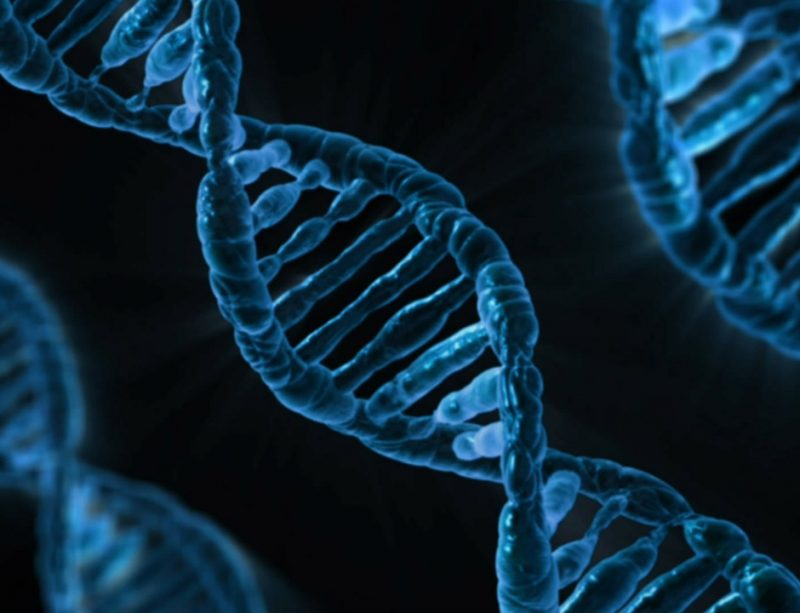
DNA is made up of a so-called double helix, in which two strands are always connected. The way in which these strands are connected is crucially important – it is the pairing of the four types of bases that matters. The adenine on one strand always pairs with the thymine on the other strand, and the cytosine pairs with the guanine. It’s called base complementarity. This ensures that when the filaments unzip (which is when cells divide), the corresponding bases line up along each filament to form the identical filament that was there before.

The secret of genes
On the DNA strands are individual genes – different lengths of which are used by the body to make proteins. There are two basic types of genes:
structural – they encode proteins that make up the building blocks of our bodies, such as collagen;
regulatory – they form proteins that influence processes in our body, such as those that are part of enzymes.
And it is precisely the process by which proteins are made according to genes that the aforementioned epigenetic reactions interfere with, which can completely block this gene transcription.
DNA contains billions of bases, but only 1.5% encode proteins. Of the other parts of the strand, the important ones for us are the so-called promoters, i.e. the sections that are upstream of each of the genes.
It is the promoters that bind the so-called transcription factors that initiate the transcription of a gene into ribonucleic acid (RNA).

Transcription is the first step in the process by which a protein is made. The second step is translation.
Transcription produces RNA. The difference between RNA and DNA is only in the different type of sugar contained (ribose instead of deoxyribose) and one base – RNA contains uracil instead of thymine. The resulting RNA is then translated to form a protein.
There are several types of RNA:
mRNA (messenger RNA) – carries the actual transcript of the gene that makes the protein;
tRNA (transfer RNA) – participates in the process of translation, during which it brings to the mRNA strand the amino acids that will form the resulting protein.
rRNA (ribosomal) – is part of the ribosomes, the little protein factories we have in our cells.
Origin of RNA – transcription
During transcription, or transcription to the promoter of the gene in question, the enzyme RNA polymerase sits, which is attracted to the promoter by transcription factors of varying strength. Transcription of the DNA to RNA is then initiated based on base complementarity (i.e. base pairing). The only change from the process of making new DNA is that a base called uracil is paired with adenine instead of thymine. This is how mRNA, tRNA, rRNA and other types of RNA are made.
Protein formation – translation
Transcription is followed by translation. This is the process by which the order of bases on the mRNA is translated into the order of amino acids that make up the protein. This happens in ribosomes, the little protein factories in our cells. And again, this is done on the basis of complementarity, because the amino acids on the mRNA strand also fit into the order of their bases. This time, however, it is not a matter of pairing, because a particular amino acid, of which there are 20 types in our body, always sits on a particular combination of three bases (the so-called triplet). The amino acids thus aligned are then joined by a peptide bond and the protein is born.

How epigenetics works
However, as we have already mentioned, proteins are not made by all genes, but only by those that are switched on. The switching on and off is done by three basic reactions, which are studied by epigenetics.
“Epi” means “above” in Greek, so it is “something above genetics”. In addition to the genome, the order of bases in DNA, there is also the epigenome – the set of chemical changes that determine the activity of individual genes. These include gene methylation, histone modification and regulation by microRNAs.
Some of these changes are even hereditary, but virtually all of them can be reversed. Unlike the genome, which is the actual structure of DNA, the epigenome is unstable and can be influenced, for example, by our lifestyle. This can, for example, increase or decrease the diseases we suffer from.
Gene methylation
During DNA methylation, a methyl group (CH3-) is attached to cytosine and guanine bases – especially those located in the promoters of individual genes. When the promoter is methylated, the gene is switched off – transcription factors and the relevant enzymes cannot find it and the transcription process cannot start. After demethylation, the gene is then switched on.
For example, if tumour suppressor genes, which are supposed to protect us from cancer, are excessively methylated, the risk of cancer increases significantly.
Histone modifications
Histones are spherical proteins on which DNA strands are wound like thread on a spool. In order for transcription to begin, the section on which the gene is located must first be unwound from the histones. The unwinding and rewinding process involves several reactions, the most important of which are acetylation and deacetylation of the histones.
When the histone is acetylated, the filament is released from it and gene reading can begin. Deacetylation then re-winds it.
Regulation by microRNA
Another epigenetic mechanism, which, unlike the previous two, does not occur at the level of transcription but translation, is regulation by microRNAs. These are short, single-stranded RNA molecules that do not code for anything, but can attach to mRNA and thus prevent translation and protein formation.
Signal pathways
The last area investigated by epigenetics is the so-called signaling pathways, which fundamentally influence the events inside the cell. These pathways are used by the cell to receive signals from its environment or to transfer information between different parts of the same cell.
Information reaches the cell by means of so-called signal molecules, which include hormones. How the information gets in depends on their properties. The cell wall is made up of fatty substances, through which fat-soluble substances can easily pass. Those that are water-soluble cannot get in. But for them there is a system of second messengers. Here, the signal molecule first binds to a specific site, the receptor, and then other substances, second messengers, begin to form inside the cell and carry the information to the cell nucleus. Subsequently, for example, the transcription of individual genes is initiated or terminated.
Many diseases are caused by disturbances in the signaling pathways. Individual signals are normally limited in time. For example, when a cell receives a signal to divide, it starts to multiply, and when the signal stops, the process of division stops. However, if the signal is not stopped, perhaps because the receptor is broken or the cell that produces the signal molecules is ‘misfiring’, rapid, uncontrolled division can occur, which becomes the basis of tumour growth.