Functioning brain, eyesight and hearing? Blood circulation is the key!
epivyziva.cz/
Zobrazeno: 721
The brain is the largest “eater” of oxygen and nutrients within our body. At rest, it receives up to a fifth of all the blood pumped by our heart. But our eyes and ears are also sensitive to sufficient blood flow. How can we improve blood flow and thus the function of all these tissues?
Research clearly shows that impaired blood flow to the brain impairs cognitive function, including memory. It also increases the risk of Alzheimer’s disease and other types of dementia. Getting more blood to this key organ is therefore crucial.
Moreover, the situation here is a bit specific, because the blood vessels in the brain differ significantly from those in the rest of the body. Within them, the blood-brain barrier separates the blood circulation from the brain tissue and protects it from the penetration of toxins and other negatively influencing substances. This barrier is secured mainly mechanically – the connections between the cells of the brain vessels are up to 100 times tighter than in other peripheral vessels. However, some types of brain cells (e.g. astrocytes) or cells of the immune system are also involved in its maintenance.
The disruption of the blood-brain barrier is typical of, for example, Alzheimer’s disease, Parkinson’s disease, multiple sclerosis or epilepsy.
Why does the blood flow to the brain stagnate?
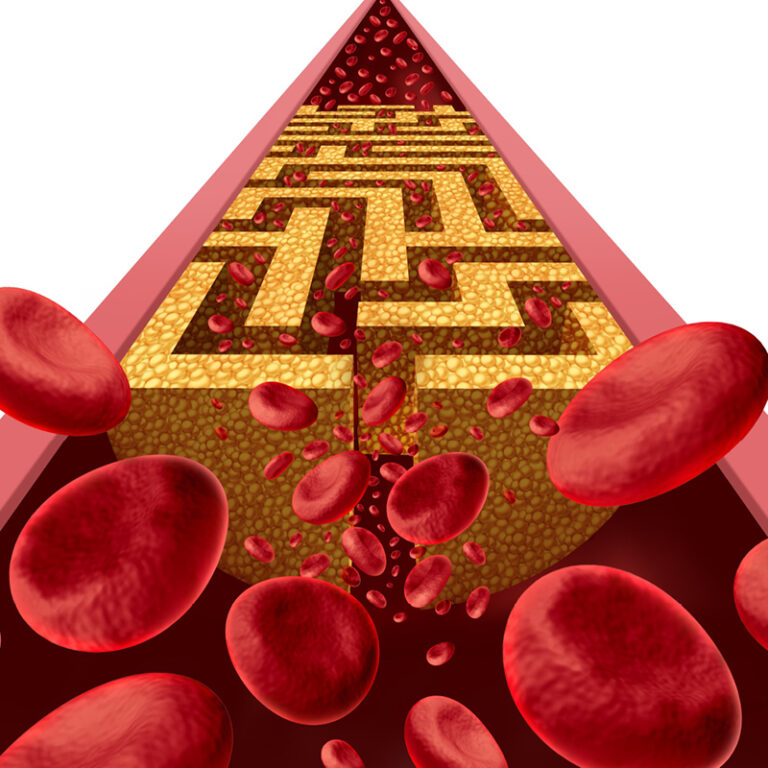
The blood supply to all tissues of the body is negatively affected mainly by atherosclerosis, or the corrosion of the arteries. This is a disease in which deposits form in the blood vessels, which narrow their permeability and impair their elasticity. Less blood flows through the blood vessels and the body’s tissues suffer from a lack of oxygen and nutrients.
Interestingly, however, this relationship also applies in reverse. In fact, insufficient blood flow through blood vessels causes epigenetic changes that result in atherosclerosis.
Impaired blood supply to the brain tissue, whether caused by chronic changes (atherosclerosis, high blood pressure) or acute changes (e.g. stroke), has another significantly negative consequence: it impairs the function of the aforementioned blood-brain barrier, in particular by causing degradation of the proteins that make it up. Its disruption then leads to the penetration of toxins into the brain, where they have a destructive effect on nerve cells, impair mental performance and can contribute, for example, to the development of Alzheimer’s disease.
But even in this type of dementia, the relationship is two-sided: blood flow through the brain can be impaired by Alzheimer’s disease itself. While in healthy people, blood flow through the brain vessels deteriorates by 0.1-0.5% per year due to ageing, the decline is 3-10 times faster in people with Alzheimer’s disease. The parts of the brain that are most affected by the disease – namely the hippocampus, where our memory resides – experience the greatest decline in blood flow. The cause is probably the accumulation of proteins (called beta-amyloid plaques) that impair the function not only of nerve cells but also of blood vessels.
For sharp eyesight and hearing
Like the brain, the eye is also sensitive to blood flow – in fact, the blood vessels in the retina and iris are very similar to those in the brain. Moreover, the blood vessels that supply the eyes are very small, so blood flow can be restricted quite easily. The eye can even be affected by a stroke, i.e. a blockage of one of the blood vessels by a blood clot. If one of the small blood vessels is affected in this way, there is usually no significant problem. However, if the main blood vessel supplying the eye is affected, vision may be temporarily impaired and, if blood circulation is not restored in time, vision may be permanently restricted or even lost.
A significant risk factor here is high blood pressure. This damages the blood vessels supplying the retina and optic nerve, which can lead to impaired blood supply and subsequent damage. However, diabetes and even autoimmune diseases also have a negative effect on the blood vessels of the eye. In these diseases, there is an increased level of inflammation in various parts of the body, and if the eye is damaged by inflammation, the condition of the blood vessels in this area is adversely affected.
Problems with blood circulation can also be one of the causes of hearing loss – the sensory cells in the ear are also demanding oxygen and nutrients. Meanwhile, research shows that hearing impairment is closely linked to blood triglyceride levels and generally poor heart health, which leads to slower blood flow.
How to improve blood circulation
So how to get more blood to the brain, eyes and ears? The basis is, of course, general care for the condition of our blood vessels and lowering blood pressure. An overview of important steps to do this can be found here “
When it comes directly to blood flow to the brain, physical activity can help significantly. For example, in one study, when a group of people aged between 55 and 80 years with mild cognitive impairment followed a one-year exercise programme involving 5 physical activities per week of 30-40 minutes duration (for example, brisk walking), they experienced significant improvements in carotid artery flexibility and increased blood flow to the brain. Further research then noted an improvement in cerebral blood flow after just a 12-week exercise program, which was associated with an improvement in mental performance. Importantly, blood flow improved through exercise not only during movement itself, but also at rest.
In addition, regular aerobic activity has also been shown in research to promote blood flow to the eyes and ears, improving the condition of these sensory organs.
Moreover, movement also directly affects the processes of atherosclerosis formation, by altering epigenetic patterns in genes related to its development.
Of course, the emphasis on healthy eating is important, especially limiting the consumption of carbohydrates with a high glycaemic index and saturated fats. Smoking is also downright harmful, as it negatively affects the blood supply to all tissues in the body, including the brain, eyes and ears. Sleep deprivation has also been shown to impair blood flow to the brain – in particular, sleep deprivation affects blood flow to areas responsible for cognitive function, even when we are doing some thought-intensive tasks.
We can also support blood circulation with dietary supplements. Here are a few scientifically proven options.
Resveratrol
The red wine dye has a number of beneficial effects on the heart and blood vessels, in addition to directly increasing blood flow to brain tissue. It is also one of nature’s most powerful enzyme activators called sirtuins. These not only help to slow down the aging process, but two of them – SIRT-1 and SIRT-3 – also have a significant protective function in the blood-brain barrier. Reveratrol also improves blood flow to the eyes. It also helps protect astrocytes, a type of cell with a distinct protective and supportive function on neurons. This is true in both the brain and the eye. In addition, astrocytes help maintain the blood-brain barrier.
Ginkgo biloba
The leaves of this tree contain several substances with strong vasodilating effects (i.e. causing blood vessels to dilate). As a result, it significantly increases blood flow to all tissues in the body, and is particularly effective in this respect in the brain. As a result, it can effectively improve mental performance, even in people suffering from Alzheimer’s disease or vascular dementia.
In addition, Ginkgo also effectively improves blood flow in the eye area, thereby improving the ability to see. Its positive effects have also been shown in the case of macular degeneration and glaucoma.
The improvement of blood circulation after administration of ginkgo biloba extract was also confirmed in the area of the ears. In addition, some studies have shown the benefit of its administration for tinnitus (ringing and ringing in the ears), but others have not confirmed its effectiveness for this problem.
Rosemary
Also a popular Mediterranean herb, it promotes blood flow to the brain, eyes and ears. It also helps protect nerve cells, promotes mental performance and memory, and is useful for macular degeneration and tinnitus.
Quercetin
A polyphenol found in a number of plant foods promotes the production of nitric oxide, which acts as a vasodilator – promoting the dilation of blood vessels and thus blood flow to many tissues in the body. In addition, it has a beneficial effect on mental performance as it promotes the proliferation of mitochondria in the brain. These cellular organelles are used to convert nutrients into energy, and when they are dysfunctional or reduced in number, the function of the relevant tissue is impaired. It is also beneficial in atherosclerosis.
Omega-3
These unsaturated fatty acids are essential for brain and eye function. Among other things, they are part of cell membranes, and their concentration is particularly high in the membranes of nerve cells. In addition, their use also improves blood flow to the brain and eyes.
Coleus forskohlii
A herb native to the Himalayas, it has extensive positive effects on the cardiovascular system. It helps to reduce blood pressure and platelet aggregation and has a vasodilating effect, thereby promoting blood flow to all tissues of the body.
Shrubby goatgrass
The herb, used mainly in traditional Chinese medicine, has a protective effect on nerve cells, helps lower cholesterol and blood pressure, improves heart function and blood flow through blood vessels, and helps alleviate hearing and vision problems.
0:00
/
0:00
Stárnutí je volba
Klíčová slova: atherosclerosis, blood flow, brain, Coleus forskohlii, ears, eyes, eyesight, Fenugreek blanched, hearing, memory, mental performance, Motion, omega-3, quercetin, resveratrol, rosemary, sleep
Komentáře
Seznam zdrojů
- Dunn et al. Flow alters genome-wide methylation, regulating endothelial gene expression and atherosclerosis. J. Clin. Invest (2014).
- Stephanie A. Ihezie, Iny Elizebeth Mathew, Devin W. McBride, Ari Dienel, Spiros L. Blackburn & Peeyush Kumar Thankamani Pandit. Fluids and Barriers of the CNS volume 18, Article number: 17 (2021)
- Anna E. Leeuwis, Lorna A. Smith, Andrew Melbourne, Alun D. Hughes, Marcus Richards,4Niels D. Prins, Magdalena Sokolska, David Atkinson, Therese Tillin, Hans R. Jäger, Nish Chaturvedi, Wiesje M. van der Flier, and Frederik Barkhof.
- Ralf W.J. Weijs, Daria A. Shkredova, Anna C.M. Brekelmans, Dick H.J. Thijssen, Jurgen A.H.R. Claassen. Longitudinal changes in cerebral blood flow and their relation with cognitive decline in patients with dementia: current knowledge and future directions. Alzheimer’s & Dementia. https://www.radboudumc.nl/en/news-items/2022/reduction-in-cerebral-blood-flow-related-to-decline-in-brain-function-in-people-with-alzheimers-dis
- Tamas Csipo, Agnes Lipecz, Cameron Owens, Peter Mukli, Jonathan W. Perry, Stefano Tarantini, Priya Balasubramanian, Ádám Nyúl-Tóth, Valeriya Yabluchanska, Farzaneh A. Sorond, J. Mikhail Kellawan, György Purebl, William E. Sonntag, Anna Csiszar, Zoltan Ungvari & Andriy Yabluchanskiy. Sleep deprivation impairs cognitive performance, alters task-associated cerebral blood flow and decreases cortical neurovascular coupling-related hemodynamic responses. Scientific Reports volume 11, Article number: 20994 (2021)
- https://www.drugs.com/health-guide/retinal-vessel-occlusion.html
- https://www.utsouthwestern.edu/newsroom/articles/year-2021/exercise-boosts-blood-flow-to-the-brain.html
- Alfini, Alfonso J | Weiss, Lauren R.c | Nielson, Kristy A.e | Verber, Matthew D. | Smith, J. Carson. Resting Cerebral Blood Flow After Exercise Training in Mild Cognitive Impairment. Journal of Alzheimer’s Disease, vol. 67, no. 2, pp. 671-684, 2019
- A Bill. Blood circulation and fluid dynamics in the eye. Physiol Rev. 1975 Jul;55(3):383-417.
- https://utswmed.org/medblog/retina-vision-exams/
- Loprinzi, Paul D., and Chelsea Joyner. “Relationship between objectively measured physical activity, cardiovascular disease biomarkers, and hearing sensitivity using data from the national health and nutrition examination survey 2003–2006.” American journal of audiology 26.2 (2017): 163-169.
- Hull, R. H., & Kerschen, S. R. (2010). The influence of cardiovascular health on peripheral and central auditory function in adults: A research review. American Journal of Audiology,19, 9-16.
- R.H.X Wong, R.S. Nealon, A. Scholey, P.R.C. Howe. Low dose resveratrol improves celebrovascular function in type 2 diabetes melitus. Nutrition, Metabolism and Cardiovaskular Disease. March 14, 2016.
- V V Neroev , T N Kiseleva, A V Chudin, A I Shchipanova K A Ramazanova. Assessing resveratrol effect on ocular blood flow in experiment. Vestn Oftalmol. 2016 Mar-Apr;132(2):55-61.
- Dalal G Al-Adwani, Waleed M Renno, Khaled Y Orabi. Neurotherapeutic effects of Ginkgo biloba extract and its terpene trilactone, ginkgolide B, on sciatic crush injury model: A new evidence. PLoS On. 2019 Dec 26;14(12):e0226626.
- Cheuvront, S. N. and Carter, R., III. Ginkgo and memory. JAMA. 2-5-2003;289(5):547-548.
- Mazza M, Capuano A, Bria P, Mazza S. Ginkgo biloba and donepezil: a comparison in the treatment of Alzheimer’s dementia in a randomized placebo-controlled double-blind study. Eur J Neurol. 2006;13(9):981-5.
- https://www.mountsinai.org/health-library/herb/ginkgo-biloba
- McCarney R, Fisher P, Iliffe S, van Haselen R, Griffin M, van der Meulen J, Warner J. Ginkgo biloba for mild to moderate dementia in a community setting: a pragmatic, randomised, parallel-group, double-blind, placebo-controlled trial. Int J Geriatr Psychiatry. 2008 Dec;23(12):1222-30.
- Jessica Minjy Kang, Shan Lin. Ginkgo biloba and its potential role in glaucoma. Curr Opin Ophthalmol. 2018 Mar;29(2):116-120.
- Jennifer R Evans. Ginkgo biloba extract for age-related macular degeneration. Cochrane Database Syst Rev. 2013 Jan 31;2013(1):CD001775.
- John C. Means, Adam A. Lopez, and Peter Koulen. Resveratrol protects optic nerve head astrocytes from oxidative stress-induced cell death by preventing caspase-3 activation, Tau dephosphorylation at Ser422 and formation of misfolded protein aggregates. Cell Mol Neurobiol. 2020 Aug; 40(6): 911–926.
- Alexander von Boetticher. Ginkgo biloba extract in the treatment of tinnitus: a systematic review. Neuropsychiatr Dis Treat. 2011; 7: 441–447.
- Kennedy DO, Scholey AB. The psychopharmacology of European herbs with cognition-enhancing properties. Curr Pharm Des. 2006;12(35):4613-23.
- Mark Moss and Lorraine Oliver. Plasma 1,8-cineole correlates with cognitive performance following exposure to rosemary essential oil aroma. Ther Adv Psychopharmacol. 2012 Jun; 2(3): 103–113.
- Nematolahi P, Mehrabani M, Kamami-Mohajeri S, Dabaghzadeh F. Effect of Rosmarinus officinalis L. on memory performance, anxiety, depresion and sleep quality in university students: A randomized clinical trial. Complement Ther Clin Pract. 2018 Feb; 30:24-28.
- Richard J. Bloomer,. John J. MacDonnchadh, Ryan Moran, Judi Quilici Timmcke. Impact of a Dietary Supplement Containing Rosemary and Daylily on Biochemical Markers of Cognitive Health, Sleep Quality and Related Variables in Men and Women. January 2016, Health 08(12):1307-1322
- Rezaie, S. R. McKercher, K. Kosaka, M. Seki, L. Wheeler, V. Viswanath, T. Chun, R. Joshi, M. Valencia, S. Sasaki, T. Tozawa, T. Satoh, S. A. Lipton.Protective effect of carnosic acid, a pro-electrophilic compound, in models of oxidative stress and light-induced retinal
- https://www.medicalnewstoday.com/articles/266370#benefits
- Nakayama H, Tsuge N, Sawada H, Higashi Y. Chronic intake of onion extract containing quercetin improved postprandial endothelial dysfunction in healthy men. J Am Coll Nutr. 2013;32(3):160-4.
- Davis JM, Murphy EA, Carmichael MD, Davis B. Quercetin increases brain and muscle mitochondrial biogenesis and exercise tolerance. Am J Physiol Regul Integr Comp Physiol. 2009 Apr;296(4):R1071-7.
- Shen Y, Ward NC, Hodgson JM, et al. Dietary quercetin attenuates oxidant-induced endothelial dysfunction and atherosclerosis in apolipoprotein E knockout mice fed a high-fat diet: A critical role for heme oxygenase-1. Free Radic Biol Med. 2013 Dec;65:908-15.
- https://is.muni.cz/th/axqzd/BP_BLAZKOVA.pdf
- Carolyn S. Kaufman, Eric D. Vidoni, Jeffrey M. Burns, Mohammed R. Alwatban, and Sandra A. Billinger. Self-Reported Omega-3 Supplement Use Moderates the Association between Age and Exercising Cerebral Blood Flow Velocity in Older Adults. Nutrients. 2020 Mar; 12(3): 697.
- J T Christenson, O Thulesius, M M Nazzal. The effect of forskolin on blood flow, platelet metabolism, aggregation and ATP release. Vasa. 1995;24(1):56-61.
- https://www.rxlist.com/astragalus/supplements.htm
- Ping Liu, Haiping Zhao, and Yumin Luo. Anti-Aging Implications of Astragalus Membranaceus (Huangqi): A Well-Known Chinese Tonic. Aging Dis. 2017 Dec; 8(6): 868–886.
- Karen Denzler, Jessica Moore, Heather Harrington, Kira Morrill, Trung Huynh, Bertram Jacobs, Robert Waters and Jeffrey Langland. Characterization of the Physiological Response following In Vivo Administration of Astragalus membranaceus. Hindawi.com, 12 Apr 2016